
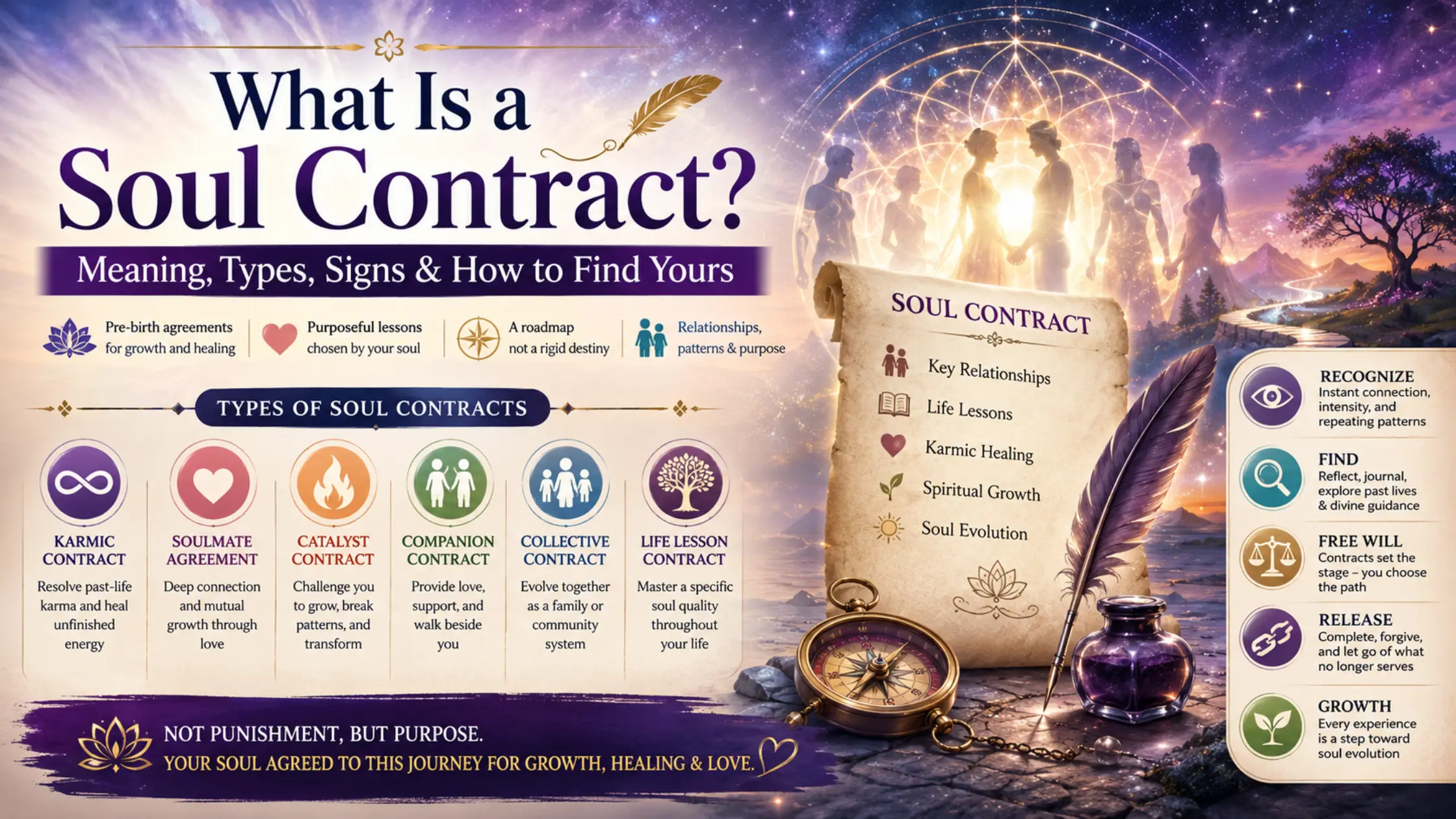
| Quick Answer: What Is a Soul Contract? A soul contract is a spiritual agreement your soul makes before birth — with other souls, your guides, and the universe — to outline the key lessons, relationships, and experiences you will encounter in this lifetime. These pre-life agreements are designed not as punishment, but as a roadmap for growth, healing, and spiritual evolution. Soul contracts shape who enters your life, the challenges you face, and the patterns that repeat until you learn from them. |
Whether you’ve felt an inexplicable connection to a stranger, experienced the same painful pattern across multiple relationships, or sensed a deeper purpose behind your suffering — soul contracts may offer a meaningful framework to understand why. In this guide, we break down everything you need to know: what soul contracts mean, the different types, how to recognise them, how to find yours, and how to release one when it’s complete.
Table of Contents
The Full Meaning of a Soul Contract: A Deeper Look
A soul contract — sometimes called a soul agreement or spiritual contract — is the idea that before you incarnate into your physical body, your soul participates in a pre-birth planning process. During this stage, your soul collaborates with other souls, spirit guides, and higher-dimensional consciousness to map out the broad strokes of your lifetime: the people you will meet, the lessons you will need to learn, and the karmic debts you will resolve.
This concept exists across many spiritual traditions, from ancient Eastern philosophy (karma and reincarnation) to New Age metaphysics and even elements of certain indigenous belief systems. The Akashic Records — a concept describing a spiritual database of all past, present, and future events — are often cited as the place where soul contracts are recorded and stored.
Importantly, soul contracts are not about fate or rigid destiny. They are better understood as a flexible blueprint rather than a fixed script. You still exercise free will in how you respond to the situations your contract outlines — but the broad themes, key people, and major turning points may already be agreed upon at the soul level.
| Key Distinction Soul Contract = the pre-life agreement (the blueprint). Soul Plan = the overall life design, which may contain multiple contracts. Karmic Contract = a soul contract specifically tied to resolving karma from past lives. |
Why Do Soul Contracts Exist?
From a spiritual perspective, the purpose of a soul contract is growth. The soul is believed to be on an ongoing journey across many lifetimes, progressively evolving toward higher states of consciousness, compassion, and understanding. Each incarnation offers specific lessons that the soul has chosen to work through.
Soul contracts exist to:
- Accelerate your spiritual evolution by placing you in situations that trigger deep learning
- Create the conditions for healing old wounds — including wounds carried from past lives
- Balance karmic energy between souls who have shared histories across multiple incarnations
- Facilitate soul group growth — helping the entire community of souls you travel with evolve together
- Provide your soul with the experiences needed to develop specific qualities: forgiveness, resilience, unconditional love, independence, or courage
The key thing to understand is that soul contracts are entered into from a place of love and wisdom, not punishment. Even contracts that involve suffering are designed to create the greatest possible opportunity for growth — both for you and for the other souls involved.
What Are the Types of Soul Contracts?
Not all soul agreements are created equal. Different types of soul contracts serve different purposes, involve different time horizons, and manifest differently in your life. Understanding the types can help you identify which contracts are currently active in your experience.
1. Karmic Contracts
Karmic contracts are agreements made to balance energy or resolve unfinished business from past lives. If a soul wronged another in a previous incarnation, both souls may agree to return together in new roles to heal, repay, or transform that karmic imbalance. These contracts often feel heavy, intense, and emotionally charged — and they frequently involve relationships that are both deeply compelling and deeply challenging.
Signs of a karmic contract: an immediate, powerful pull toward someone; a feeling that you have unfinished business together; an intense push-pull dynamic; repeating arguments or patterns; a sense that you cannot leave even when logic says you should.
2. Soul Agreements with Soulmates
Many people use the word ‘soulmate’ to mean a romantic partner — but spiritually, a soulmate is simply a soul with whom you have a deep, recurring connection across lifetimes. You may have many soulmates, and they can appear as romantic partners, close friends, mentors, or siblings. Soul agreements with soulmates are typically loving, supportive contracts designed to nurture your growth.
3. Catalyst Contracts
Catalyst contracts involve souls who enter your life specifically to shake things up. These are the people who challenge you, provoke you, or push you out of your comfort zone. A difficult parent, a betraying friend, or a disruptive colleague may all be fulfilling catalyst contracts. Their role is not to harm you permanently, but to create the friction necessary for transformation.
Catalyst contracts are often mistaken for purely negative experiences — but looking back, most people can identify at least one difficult relationship that was ultimately their greatest teacher.
4. Companion Contracts
Companion contracts are agreements with souls who are here simply to walk alongside you — to provide love, support, stability, and companionship. These are your lifelong friends, loving partners, and loyal family members who seem to always show up when you need them most. These contracts feel comfortable, safe, and deeply familiar from the first meeting.
5. Karmic Group or Collective Contracts
Some contracts are not individual but collective — agreements made by a group of souls to experience something together for the purpose of collective evolution. This can include being born into a particular family system, culture, or historical period. People who share a collective karmic contract often feel a sense of group purpose or shared mission.
6. Life Lesson Contracts
These are contracts tied not to a specific person, but to a specific theme or lesson your soul has committed to mastering in this lifetime. Common life lesson contracts include learning unconditional love, overcoming fear, developing self-worth, learning forgiveness, or cultivating courage. These themes tend to run through all your relationships and experiences like a consistent thread.
Here is a quick reference summary of the main types of soul contracts:
| Type | Primary Purpose | How It Feels |
| Karmic Contract | Balance past-life karma | Intense, heavy, magnetic, sometimes painful |
| Soulmate Agreement | Nurture growth through love | Deep familiarity, comfort, mutual support |
| Catalyst Contract | Trigger transformation through challenge | Difficult, disruptive, but ultimately instructive |
| Companion Contract | Provide love and companionship | Safe, warm, consistently supportive |
| Collective Contract | Evolve as a group or family system | Shared purpose, group identity |
| Life Lesson Contract | Master a specific soul quality | A recurring theme across all areas of life |
How to Recognize a Soul Contract in Your Life
One of the most common questions people have about soul contracts is: How do I know if someone or something is part of mine? While there is no definitive spiritual test, there are several consistent signs that spiritualists and researchers in this field associate with active soul contracts.
Instant Recognition or Deep Familiarity
When you meet someone who is part of your soul contract, you may feel an immediate and inexplicable sense of familiarity — as if you have known this person for years, even though you have just met. This is sometimes described as a sense of coming home. It can happen with romantic partners, friends, teachers, or even strangers who say exactly the right thing at exactly the right time.
Intense and Difficult Relationships
Not all soul contracts feel pleasant. Some of the most powerful contracts involve relationships that are deeply difficult — toxic partnerships, complicated family dynamics, or rivalries that force you to grow. The intensity itself is often a signal. If a relationship affects you far out of proportion to how long you have known the person, a soul-level agreement may be at work.
Repeating Lessons and Patterns
If you find yourself experiencing the same type of challenge repeatedly — the same kind of partner, the same workplace conflict, the same emotional wound — this repetition is often a signal that a soul contract lesson has not yet been integrated. The pattern continues until the lesson is fully learned. Once you genuinely understand and shift the core dynamic, the pattern often dissolves.
Unexplained Pulls Toward a Place, Path, or Purpose
Soul contracts are not only about people. You may feel a magnetic pull toward a specific career, geographic location, creative pursuit, or cause that you cannot rationally explain. These pulls are sometimes interpreted as the soul recognizing an element of its pre-birth agreement — a place it committed to living, a work it committed to doing.
A Relationship That Ends Suddenly and Naturally
When a soul contract is complete, the connection it supported often dissolves naturally. Two people may drift apart with no dramatic falling out — simply a quiet ending. This is one of the most commonly noted signs that a contract has been fulfilled. Rather than viewing it as a loss, many spiritual practitioners interpret it as evidence that both souls have completed what they came together to do.
What Is My Soul Contract? How to Find Yours
Finding your soul contract is less about receiving a literal document and more about developing spiritual self-awareness — learning to read the recurring themes, relationships, and lessons your soul has chosen for this lifetime. Here are the most commonly recommended practices.
1. Reflect on Your Core Life Themes
Look at the recurring threads in your life. What challenges have followed you from childhood into adulthood? What qualities do you seem to be developing through repeated difficulty? What kinds of relationships or dynamics do you consistently attract? These themes are often direct expressions of your active soul contracts.
2. Journal About Your Most Impactful Relationships
Write about the people who have had the biggest impact on your life — for better or worse. For each person, explore: What did I learn from this relationship? What did I struggle to change? Was there a sense of deep familiarity or unfinished business? These reflections can illuminate which types of contracts have been most active for you.
3. Explore Past-Life Regression or Akashic Records Reading
Past-life regression — typically done through guided hypnosis with a trained facilitator — is one practice used to uncover karmic contracts and past-life agreements. Akashic Records readings, offered by certain spiritual practitioners, are another avenue. While these are not scientifically validated, many people report profound insights about recurring patterns and relationships from these experiences.
4. Numerology and Soul Contract Reading
Some practitioners use numerology — particularly the study of your birth name and birth date — as a tool for soul contract reading. The belief is that the numbers encoded in your name and date of birth carry information about your soul’s chosen lessons and agreements. This is sometimes also called a birth-chart soul contract reading, similar in some ways to how a zodiac soul contract or astrological chart is interpreted.
5. Pay Attention to Synchronicities
Synchronicities — meaningful coincidences that seem too specific to be random — are often interpreted as the universe signaling your soul contract themes. A book that falls off a shelf at the perfect moment, meeting a stranger who delivers exactly the message you needed, or an opportunity appearing right after a prayer or intention — these experiences may be your soul’s contract making itself known.
Soul Contracts and Free Will: Are You Trapped?
One of the most important misconceptions about soul contracts is the belief that they eliminate free will or lock you into a predetermined fate. This is not how the concept works in most spiritual traditions. Soul contracts define the terrain, not the journey.
Think of it this way: your soul may have agreed to experience a challenging childhood as part of its contract to develop resilience. But how you respond to that childhood — whether you allow it to define you negatively, seek healing, use it to build empathy, or transform it into purpose — is entirely within your free will. The contract sets up the opportunity; you choose what to do with it.
This distinction matters because it prevents spiritual fatalism — the idea that nothing can be changed because it was all ‘meant to be.’ Soul contract philosophy, properly understood, is actually deeply empowering: it suggests that every difficulty in your life has a higher-level purpose, and that you have the capacity to learn, grow, and even release contracts that no longer serve you.
| Soul Contract vs. Soul Plan vs. Destiny Soul Contract: a specific agreement with another soul or set of souls about particular lessons or roles. Soul Plan: the broader blueprint your soul has designed for this lifetime, encompassing multiple contracts. Destiny: the possible outcomes available to you based on your plan — but shaped and chosen through free will. None of these eliminate choice. They provide the framework within which your choices are made. |
Breaking Soul Contracts: Can You Release Them?
Yes — according to most spiritual frameworks, it is possible to release, break, or renegotiate a soul contract. This is not always easy, and not all contracts should be broken. Some contracts need to be honored and completed for both souls to receive the growth they agreed to. But others — especially those that have become toxic, damaging, or no longer serve the evolution of either soul — can be consciously released.
Signs a Soul Contract May Need to Be Released
- The relationship has become consistently harmful rather than growth-promoting
- The lesson that was meant to be learned has been learned, but the relationship persists out of habit or fear
- You feel spiritually drained, not energized or challenged in a healthy way
- The same painful dynamic repeats without any movement or growth
- Both souls involved are suffering without any apparent purpose
How to Release a Soul Contract
The most widely recommended approaches to releasing soul contracts combine intention-setting with energetic or ritual practice:
- Conscious Intention: Clearly state — aloud or in writing — your intention to release the contract. Acknowledge the lessons it brought you and express gratitude for them.
- Forgiveness Work: Soul contracts, especially karmic ones, are often held in place by unforgiveness — either of the other person or of yourself. Genuine forgiveness is frequently the mechanism that allows the contract to complete.
- Meditation and Visualization: Many practitioners use guided meditation to visualize cutting cords or releasing energetic ties to a specific person or contract.
- Working with a Spiritual Facilitator: Akashic Records practitioners, energy healers, and spiritual coaches can sometimes assist in releasing deeply held contracts.
- Setting New Intentions: Once a contract is released, consciously setting new intentions for how you want to attract relationships and experiences going forward helps your soul align with its next agreements.
It is worth noting that releasing a soul contract does not necessarily mean removing a person from your life — it means releasing the agreement that had bound you both to a specific dynamic. The relationship can continue, but in a new, healthier form.
Soul Contracts and Karmic Relationships: What’s the Difference?
Karmic relationships are a specific subset of soul contracts. All karmic relationships involve a soul contract, but not all soul contracts are karmic. The distinction lies in the history between the souls involved.
| Karmic Relationship | Soul Contract (Broader) |
| Rooted in past-life history | May or may not involve past lives |
| Often involves unresolved energy or debt | Can involve completely new agreements |
| Frequently intense and challenging | Can range from gentle to intense |
| Focused on balancing specific energy | Focused on any agreed lesson or experience |
| May feel compulsive or inescapable | Can feel natural and freely chosen |
Birth Month, Zodiac, and Soul Contracts: Are They Connected?
Some spiritual traditions and practitioners associate soul contract themes with the time of birth — including birth month and astrological sign. The idea is that your soul chooses not only the lessons it will learn, but the specific cosmic conditions under which it will incarnate — and the alignment of planets and celestial bodies at the moment of birth may reflect or amplify certain contract themes.
For example:
- Fire signs (Aries, Leo, Sagittarius) are sometimes associated with soul contracts around leadership, courage, and identity.
- Water signs (Cancer, Scorpio, Pisces) are linked to contracts involving emotional healing, intuition, and deep relational bonds.
- Earth signs (Taurus, Virgo, Capricorn) may carry contracts around material mastery, stability, and service.
- Air signs (Gemini, Libra, Aquarius) are often connected to contracts around communication, relationships, and collective evolution.
Birth month soul contracts — sometimes explored through numerology or astrology — offer one framework for understanding your soul’s primary agreements. While these systems are not scientifically verified, many people find them useful for reflection and self-inquiry.
Common Misconceptions About Soul Contracts
Several widespread misunderstandings can lead people to misuse or misinterpret the soul contract framework. These are worth addressing directly.
Misconception 1: Soul Contracts Justify Abuse or Harm
This is perhaps the most dangerous misuse of the concept. Because soul contracts involve difficult relationships for growth purposes, some people rationalize staying in genuinely abusive situations by telling themselves ‘this must be my soul contract.’ This is a form of spiritual bypassing — using spiritual ideas to avoid addressing real harm. Learning a soul lesson does not require enduring sustained abuse. You can honor the lesson and still leave.
Misconception 2: All Suffering Has a Soul Contract Reason
While the soul contract framework suggests purpose behind many experiences, this does not mean every act of suffering carries a neat spiritual meaning. Applying this idea too rigidly can lead to victim-blaming or dismissing genuine trauma. The framework is a lens for reflection, not a rigid explanation for all of life’s pain.
Misconception 3: Soul Contracts Are Permanent
As covered above, soul contracts can be completed, fulfilled, or released. They are dynamic, not permanent fixtures. Growth is possible, change is possible, and even the most deeply held karmic patterns can shift when the internal work is genuinely done.
Frequently Asked Questions
What are soul contracts?
A soul contract is a pre-birth spiritual agreement your soul makes — with other souls, spirit guides, and the universe
— about the key relationships, experiences, and lessons it will encounter in this lifetime. These agreements are
designed to facilitate spiritual growth, heal karmic wounds, and fulfill your soul’s evolutionary purpose.
What are the types of soul contracts?
The main types include: karmic contracts (resolving past-life energy), soulmate agreements (nurturing growth through love),
catalyst contracts (triggering transformation through challenge), companion contracts (providing support),
collective/group contracts (shared karmic themes across a family or community), and life lesson contracts
(mastering a specific spiritual quality throughout your life).
Can soul contracts be broken?
Yes. Soul contracts can be completed, fulfilled, or consciously released. Practices such as forgiveness work,
intention-setting, meditation, cord-cutting visualization, and working with spiritual facilitators are
commonly used to release contracts that are no longer serving either soul involved.
How do I find my soul contract?
Reflect on your recurring life themes, your most impactful relationships, and the lessons that seem to follow you.
Journaling, past-life regression, Akashic Records readings, and numerology-based soul contract readings
are all practices used to gain insight into your soul’s pre-birth agreements.
Are soul contracts the same as karmic contracts?
Not exactly. All karmic contracts are soul contracts, but not all soul contracts are karmic.
Karmic contracts specifically involve resolving energy or lessons from past lives, while
soul contracts can also include completely new agreements with no past-life history.
What are soul agreements vs soul contracts?
The terms are used interchangeably in most spiritual contexts. Some practitioners distinguish them
by suggesting soul agreements are broader (encompassing general life themes) while soul contracts
are more specific (involving particular relationships or events). In practice, both refer to pre-birth
commitments your soul makes for its evolutionary journey.
Does everyone have a soul contract?
In the spiritual framework that teaches soul contracts, yes — all souls are believed to enter physical
life with some form of pre-birth agreement or soul plan in place. The specific content, complexity,
and number of contracts varies from soul to soul based on its stage of evolution and chosen lessons.
What happens when a soul contract ends?
When a soul contract is fulfilled, the relationship or dynamic it supported often shifts naturally.
People may drift apart, a recurring pattern may stop, or a chapter of life may close. This is typically
experienced as a sense of completion or release — sometimes peaceful, sometimes bittersweet.
Conclusion: Understanding Your Soul Contract
A soul contract is one of the most profound frameworks available for making sense of the relationships, challenges, and patterns that define your life. At its core, the concept invites you to see your experiences not as random misfortune, but as purposeful agreements your soul made from a place of wisdom and love before you were born.
Understanding what a soul contract is — and the different types of soul contracts that may be active in your life — can shift your relationship to difficulty. The painful relationship that seemed pointless becomes a karmic contract you are here to heal. The person who challenged you most becomes a catalyst you agreed to learn from. The recurring lesson you cannot escape becomes the very growth your soul came here to achieve.
Whether you are looking to find your soul contract, understand its meaning, or release one that has run its course, the most important tool at your disposal is your own self-awareness. Pay attention to your patterns, your deepest relationships, your recurring themes. Your soul contract is not hidden from you — it is written in the very experiences that have shaped you most.
| Key Takeaways A soul contract is a pre-birth agreement about your life’s key lessons, relationships, and experiences. Soul contracts come in several types: karmic, soulmate, catalyst, companion, collective, and life lesson. They are blueprints, not scripts — you still have free will in how you respond. Signs of a soul contract include instant connection, intense relationships, and repeating life patterns. Soul contracts can be completed, fulfilled, and consciously released when they are no longer serving growth. Misconceptions about soul contracts include using them to justify abuse or dismiss trauma — always use the framework with discernment. |

Leave a Reply