
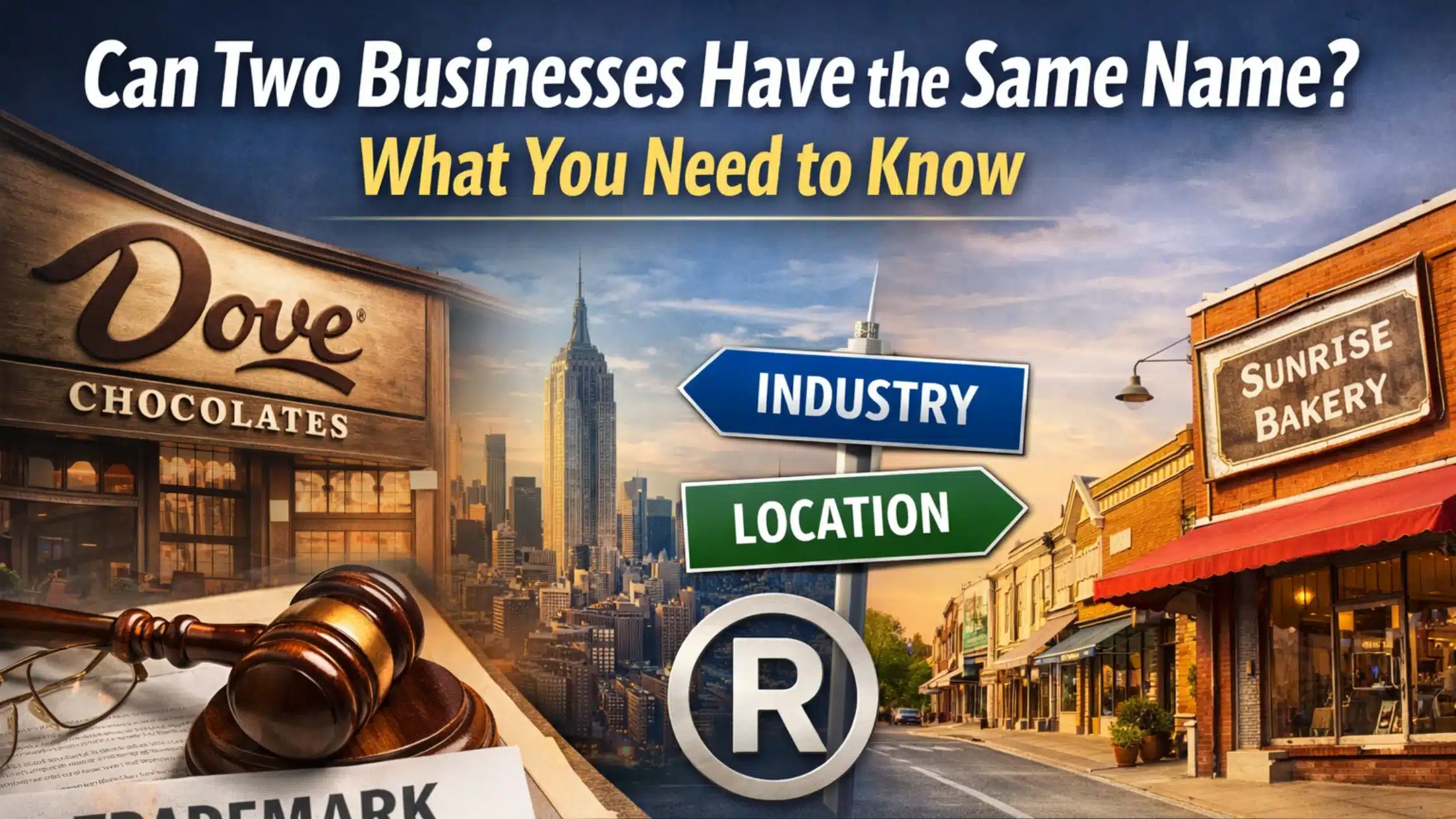
Yes, two businesses can have the same name. However, doing so carries significant legal and branding risks. Whether it is allowed depends on three key factors: the industry each business operates in, the geographic region, and whether either name is trademarked. Two companies in completely different industries — like Dove soap and Dove chocolate — can legally share a name. But if both operate in the same market, trademark law may prohibit it entirely.
If you are launching a new business and wondering whether your chosen name is already in use — or whether a competitor can legally use your existing name — this guide covers everything you need to know. From trademark law and state registration rules to real-world examples and how to protect your brand, we break it all down clearly.
Table of Contents
Can Two Businesses Have the Same Name?
The short answer is yes — but it is complicated. Two businesses can share the same name legally under certain conditions, but it is rarely advisable. The legal system does not automatically prevent two companies from having identical names. Instead, the rules depend on a combination of trademark registration, geographic scope, and industry classification.
There is no single national registry that prevents identical business names from existing simultaneously. A business name registered in Texas as a sole proprietorship, for example, does not automatically stop a different business in Florida from using the same name. Federal trademark law, however, creates a much broader layer of protection that supersedes state-level registration.
The central concept here is consumer confusion. Courts and trademark offices evaluate whether two similar or identical names are likely to confuse customers about the source of goods or services. If confusion is unlikely — because the businesses operate in totally different fields or regions — the names may coexist. If confusion is likely, trademark law steps in.
When It Is Legally Allowed for Two Companies to Have the Same Name
Several conditions allow two businesses to legally share the same or very similar name without conflict:
1. Different Industries
One of the clearest cases of lawful name-sharing is when the two businesses operate in entirely different industries. The classic example is Dove — a brand name used by both a personal care company (owned by Unilever) and a chocolate brand (owned by Mars). These two products serve completely different consumer needs, and no reasonable customer would confuse them.
This principle is baked into trademark law. Trademark rights are specific to the goods or services a company registers for. A tech firm called “Apex” and a landscaping business called “Apex” may both exist legally, because their customers, products, and markets do not overlap.
2. Different Geographic Markets
Two businesses can have the same name if they serve genuinely non-overlapping geographic markets and neither holds a federal trademark. A small bakery called “Golden Crust” in rural Montana and another in rural Georgia may never compete for the same customers.
This protection erodes quickly, however, once either business expands or goes online. The internet has effectively collapsed geographic distance for branding purposes. If both businesses operate websites or ship nationally, their geographic separation no longer insulates them from a conflict.
3. No Federal Trademark Has Been Filed
If neither business has registered a federal trademark, both may operate under the same name — though both take on risk. In that situation, the company that can prove it used the name first in commerce generally has superior rights under the “prior use” doctrine. This can become expensive to establish in court.
| Key Rule: The Consumer Confusion Test The central legal question is always: Would a reasonable customer be confused about which company they are dealing with? If the answer is yes, there is likely a trademark conflict. If the answer is no — because the businesses are in different industries or markets — both names may legally coexist. |
When It Is NOT Allowed: Trademark Law Explained
Trademark law is where same-name conflicts most commonly turn into legal battles. Here is how it works:
Federal Trademark Registration (USPTO)
In the United States, businesses can register their name as a trademark with the U.S. Patent and Trademark Office (USPTO). A federal trademark gives the registrant exclusive nationwide rights to use that name in connection with the specific goods or services listed in the registration.
If a business has a registered federal trademark and another company starts using the same or a confusingly similar name in the same industry, the trademark holder can sue for infringement. This can result in court orders to stop using the name, monetary damages, and legal fees.
Common Law Trademark Rights
Even without a registered trademark, a business builds “common law” trademark rights simply by using a name in commerce. If your business has operated under a name for years and built a customer base, you may have enforceable rights — even without formal registration. However, those rights are limited to the geographic area where your business actually operates and is known.
Federal registration strengthens those rights enormously by providing nationwide protection and creating a legal presumption that you own the mark.
Likelihood of Confusion Standard
Courts use a multi-factor test to determine if two names create a likelihood of confusion. The key factors include:
- The similarity of the names in appearance, sound, and meaning
- The relatedness of the products or services each business offers
- The strength of the original mark (is it distinctive or generic?)
- The channels of commerce (do both businesses market in the same way?)
- Evidence of actual consumer confusion
- The sophistication of buyers in that market
The more factors that point toward likely confusion, the stronger the trademark infringement claim.
| Scenario | Same Name Allowed? | Risk Level |
| Different industries, no trademarks | Generally Yes | Low |
| Different geographic markets, no online presence | Possibly | Medium |
| Same industry, one has federal trademark | No | Very High |
| Same industry, neither has trademark | Technically Yes | High |
| Both have trademarks in different classes | Yes | Low |
| One has common law rights, same region | Disputed | Medium-High |
State Registration vs. Federal Trademark: What Is the Difference?
Many entrepreneurs confuse state business registration with trademark protection. These are two completely different things, and conflating them is one of the most common — and costly — mistakes a new business owner can make.
State Business Registration
When you register a business name with your state (as a sole proprietor, LLC, or corporation), the state will typically require that the name not be identical to an existing registered business within that state. This prevents confusion at the administrative level.
But state registration offers no trademark protection. It does not stop a company in another state from using the same name. It does not prevent someone from registering the name federally. It does not give you the right to sue for trademark infringement.
Federal Trademark Registration
A federal trademark — filed through the USPTO — provides nationwide protection. It creates a public record that you claim ownership of the mark. It gives you the legal right to use the ® symbol. And critically, it enables you to take legal action against infringers anywhere in the country.
Federal trademarks are also reviewed before approval. The USPTO examines applications and will reject a new mark if it is too similar to an existing registered mark in the same industry.
| State Registration vs. Trademark: At a Glance State Registration: Prevents name duplication within one state only. No IP protection. Federal Trademark: Nationwide protection. Enables infringement lawsuits. Creates legal presumption of ownership. Bottom Line: State registration is the minimum. A federal trademark is the gold standard. |
Real-World Examples of Businesses Sharing the Same Name
Looking at real-world examples makes the rules clearer:
Dove: Personal Care vs. Chocolate
Dove soap (Unilever) and Dove chocolate (Mars) are the most cited example of two large companies sharing an identical brand name. Both operate in the consumer goods space broadly, but their specific products, customer experience, and distribution channels are different enough that no consumer confusion arises. Neither company has moved to force the other out.
Delta: Airlines, Faucets, and Dental
The name “Delta” is used by Delta Air Lines, Delta Faucet, and various other businesses across unrelated industries. Each company operates in a distinct market.
Delta Air Lines holds trademark rights in aviation; it does not hold them in plumbing fixtures. This cross-industry name sharing is common for strong, generic words.
Amazon: The Retailer and the River
Amazon.com obviously dominates the brand. But “Amazon” as a geographic reference remains free to use. Small tour operators, conservation nonprofits, and regional businesses using “Amazon” in a descriptive geographic context are unlikely to face legal action — especially if there is no plausible consumer confusion with the e-commerce giant.
Small Business Example: Two “Sunrise Bakeries”
Imagine two small bakeries, both called “Sunrise Bakery” — one in Portland, Oregon, and one in Portland, Maine. If neither has a federal trademark and both operate only locally with no online sales, they may coexist indefinitely. But the moment one files for a federal trademark or begins national shipping, the other faces potential legal exposure.
How to Check If a Business Name Is Already Taken
Before settling on a name, every business owner should conduct a thorough name search. Here is a step-by-step process:
- Search the USPTO Trademark Database (TESS)
Visit the USPTO’s Trademark Electronic Search System at tess.uspto.gov. Search for your proposed name and variations of it. Look for registered marks in your industry’s classification codes (called “International Classes” or IC). A trademark attorney can help interpret results.
2. Search Your State’s Business Registry
Each state maintains a registry of registered business names. Search your Secretary of State’s website for existing businesses with the same or similar name. This step is required before incorporating in most states.
3. Run a General Web Search
A Google search for your proposed name is a simple but important step. Look for businesses using the name in your industry. Check social media platforms as well — a business may not have a trademark but could have an established online brand.
4. Check Domain Name Availability
Check whether the .com domain is available for your name. If it is taken by a business in your industry, this is a red flag. Domain name conflicts can also lead to legal disputes under the Anticybersquatting Consumer Protection Act (ACPA).
How to Protect Your Business Name
Once you have chosen a name and confirmed it is available, these steps will protect your rights:
File a Federal Trademark Application
This is the most powerful protection available. File with the USPTO using either an “Intent to Use” application (if you have not launched yet) or a “Use in Commerce” application (if you are already operating). The process takes several months and a moderate fee, but the protection it confers is national and long-lasting.
Register at the State Level
Register your business name as a legal entity — LLC, corporation, or DBA (Doing Business As) — with your state. While this does not provide trademark rights, it does create a formal record and may deter others from filing a similar name in the same state.
Secure Your Domain Name
Purchase your .com domain name immediately. If the .com is unavailable, this may be a signal to revisit your name choice. Also secure social media handles on major platforms to prevent brand confusion online.
Use the Name Consistently in Commerce
Common law trademark rights grow over time through consistent, public use of your name. The more prominently and consistently you use your business name — on products, invoices, marketing materials, websites — the stronger your claim becomes. Document your first use date and maintain records.
Work With a Trademark Attorney
A trademark attorney can conduct a more thorough clearance search, advise on the strength of your mark, and manage the USPTO filing process. For any business where the name is a critical brand asset, this investment is worthwhile.
What to Do If Another Business Is Using Your Name
Discovering that another business is using your name — or a name very similar to yours — can be alarming. Here is how to respond strategically:
Assess the Actual Risk
Not every name overlap is a genuine legal problem. Ask yourself: Are they in the same industry? Are they targeting the same customers? Is there evidence of real consumer confusion? If the overlap is in a completely different field or region, the risk may be minimal.
Send a Cease and Desist Letter
If you have trademark rights — registered or common law — and the other business is creating confusion in your market, the first step is typically a formal cease and desist letter. This letter notifies the other business of your rights and requests that they stop using the name. Many disputes are resolved at this stage without litigation.
File a Trademark Opposition or Cancellation
If the other business has filed for a trademark that you believe conflicts with yours, you can file an opposition during the USPTO’s 30-day publication window. If the trademark has already been registered, you can file a cancellation petition. Both procedures are handled before the Trademark Trial and Appeal Board (TTAB).
Consider Negotiation and Co-Existence Agreements
In some situations, both businesses may prefer to negotiate a co-existence agreement rather than engage in costly litigation. These agreements define the conditions under which both can continue to use similar names — often by limiting geographic scope, industry use, or marketing channels.
Pursue Litigation as a Last Resort
If other remedies fail, trademark infringement lawsuits are an option. Successful claimants can recover damages, lost profits, legal fees, and a permanent injunction ordering the other party to stop using the name. Litigation, however, is expensive and time-consuming. It is typically reserved for high-value brand disputes.
Common Mistakes Business Owners Make With Business Naming
Understanding what not to do is just as valuable as knowing the rules. Here are the most frequent naming mistakes that create legal exposure:
- Assuming state registration equals trademark protection — it does not
- Choosing a generic or descriptive name that is nearly impossible to trademark (e.g., “Fast Delivery Services”)
- Skipping the USPTO trademark search before investing in branding and marketing
- Ignoring the risk of a name because your business is currently small — growth changes everything
- Neglecting domain name and social media handle availability when evaluating a name
- Waiting too long to file a trademark — the longer you wait, the more a competitor can build common law rights
- Assuming geographic distance protects you permanently — online commerce erases geographic barriers
- Using a name that is merely similar (not identical) to a registered mark without legal review — similarity can still constitute infringement
Conclusion
Can two businesses have the same name? Yes — but that does not mean they should. The legality of sharing a business name depends heavily on industry, geography, and trademark status. Two companies in completely different fields can coexist under the same name, as Dove soap and Dove chocolate demonstrate. But when businesses compete in the same market for the same customers, identical or confusingly similar names create serious legal and brand risks.
The safest path forward is always to conduct a thorough trademark search before committing to a name, register a federal trademark as early as possible, and secure your domain name and online presence. State business registration is only the first step — it does not protect your brand.
If you discover another business using your name, assess the actual risk of consumer confusion before taking action. In many cases, businesses can coexist. In others, a cease and desist letter or USPTO opposition may be necessary. For high-stakes brand disputes, a qualified trademark attorney is an indispensable resource.
Frequently Asked Questions
Can two businesses have the same name in different states?
Yes, two businesses can share the same name if they are registered in different states and neither holds a federal trademark. However, if either business operates online or expands nationally, this can lead to conflict. Federal trademark registration overrides state-level name registration and provides nationwide protection.
Can two companies have the same name if they are in different industries?
Generally, yes. Trademark law protects against consumer confusion. If two businesses operate in entirely different industries and serve completely different customers, the same name can be used by both. The classic example is Dove soap versus Dove chocolate — both are major brands sharing a name without legal conflict.
Can you have the same business name as someone else without a trademark?
If neither party holds a federal trademark, both businesses may technically use the same name. However, the business that first used the name in commerce may have common law trademark rights, allowing them to take legal action. Without formal registration, proving these rights in court is costly and uncertain.
What happens if another business registers my name as a trademark?
If a competitor registers your name as a federal trademark and you have been using the name first, you can challenge the registration through the USPTO’s Trademark Trial and Appeal Board (TTAB). You would need to prove prior use. This is why filing a federal trademark promptly — rather than relying on common law rights — is strongly recommended.
Can two LLCs have the same name?
Two LLCs can share the same name only if they are registered in different states. Most states will not allow a new LLC to register a name that is identical or too similar to an existing LLC in that state. However, there is no national database preventing the same LLC name from existing in multiple states simultaneously.
Can businesses have the same name internationally?
Yes. Trademarks are territorial — a U.S. trademark does not protect your name in the UK, Canada, or Australia. Two businesses can share the same name in different countries unless one has filed international trademark protection through systems like the Madrid Protocol. For businesses with global ambitions, international trademark registration is essential.
What is the first-to-use rule for business names?
The first-to-use rule (also called “prior use” doctrine) holds that the company that first uses a name in commerce has superior rights over later users, even without federal registration. If a dispute arises, the prior user can present evidence of their first use date — such as early invoices, advertising records, or product packaging — to establish their claim.
How do I know if a business name is trademarked?
Search the USPTO’s Trademark Electronic Search System (TESS) at tess.uspto.gov. Enter your proposed name and review any active or pending registrations. Also search for phonetically similar names and common misspellings. For a comprehensive clearance search, consult a trademark attorney who can evaluate risk across multiple databases and common law uses.
Can a sole proprietor and an LLC have the same business name?
They can in some jurisdictions, especially if in different states. However, if the LLC has a trademark or common law rights to the name, the sole proprietor may be at risk of an infringement claim regardless of business structure. The entity type (LLC vs. sole proprietor) is irrelevant to trademark law — rights are based on use and registration, not structure.

Leave a Reply